What Is a Sensory Swing? A Parent's Guide
Published 20 October 2026
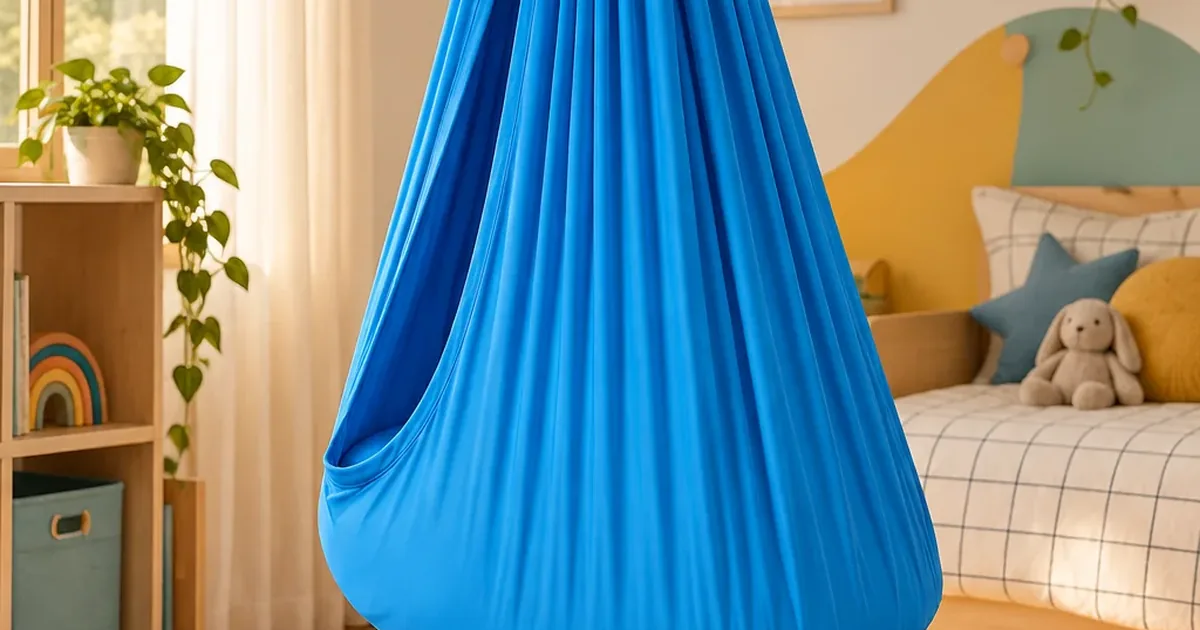
A sensory swing is a fabric swing that wraps around a child instead of giving them a flat seat to sit on. It hangs indoors, usually from a single ceiling point, and the child can sit in it, lie back, curl up or rock gently while the fabric holds them on every side. Many families use one as a quiet corner as much as a swing.
This guide explains how sensory swings work, how they differ from the swing in the garden or the club, what the research actually says, and how to decide whether one is right for your child.
How a sensory swing works
Two of the body's senses get less attention than sight and hearing, and both are involved when a child swings.
- The vestibular sense is the balance system in the inner ear. It tells us when we are moving, how fast, and which way is up. NHS training material for families and staff describes smooth, rhythmic swinging as an activity that tends to calm, and fast or spinning movement as one that tends to alert (Derbyshire Healthcare NHS FT).
- The proprioceptive sense comes from muscles and joints. It tells the body where its parts are and how much force it is using. Firm, even pressure — the kind a snug blanket or a hug gives — is a proprioceptive experience (East London NHS FT).
A stretchy sensory swing combines the two: gentle movement, and the even pressure of fabric closing around the body. That is why some children find one comforting, and why others simply enjoy it as play.
Sensory swing, compression swing, sensory hammock: what's the difference?
The names overlap, and shops use them loosely.
- Compression swing or Lycra swing: a long panel of stretchy fabric that closes snugly around the child. "Compression" describes the stretch.
- Sensory hammock: often the same product, sometimes a wider, hammock-shaped sling.
- Pod or cocoon swing: a rounder, more enclosed shape, often in thicker fabric.
- Platform or bolster swing: rigid equipment used in clinic sensory rooms, not usually a home product.
The CIPPO Sensory Swing is a compression swing: a 300 × 180 cm panel of 100% Lycra with four-way stretch, designed for children aged 4–12.
How is it different from a regular swing?
- Seat: a playground or garden swing has a flat seat or a tyre. A sensory swing is fabric that wraps around the body.
- Where it hangs: a playground swing hangs outdoors on a frame. A sensory swing hangs indoors from a structural anchor.
- Movement: big back-and-forth arcs on a playground swing; gentler rocking and swaying in a sensory swing.
- Pressure: a playground swing gives none. A sensory swing gives the even pressure of the stretch.
- Other uses: a sensory swing is also a place to rest, curl up or have a quiet corner.
What the research says — and what it doesn't
It helps to be clear about this, because sensory swings are often sold with big promises.
- Swings are among the equipment clinicians use to provide movement and pressure input. The American Academy of Pediatrics notes this, and also says that research on sensory-based interventions is limited and inconclusive; it advises families to agree goals and review progress when such approaches are tried (AAP, Pediatrics, 2012).
- A systematic review of interventions for sensory challenges in autism rated the evidence as low or insufficient, with at most modest, short-lived benefits (Weitlauf et al., Pediatrics, 2017).
- Structured, individualised intervention delivered by a trained clinician (Ayres Sensory Integration) has stronger evidence for helping autistic children reach their own goals than single sensory tools used on their own (Schoen et al., Autism Research, 2019; Case-Smith et al., Autism, 2015). That evidence is about a clinician-led intervention, not a product.
- A 2025 systematic review of sensory-based interventions found no significant benefit from linear swinging on children's behaviour during table-top tasks (Frontiers in Pediatrics, 2025).
So the honest summary is this: a sensory swing is a home product for movement, play and rest. Many children love one. It is not a treatment for autism, ADHD, anxiety or any other condition, and no swing should be bought on that promise.
Which children enjoy one?
Children are different, and their preferences change from day to day. Some seek movement and pressure and will spend a long time in a swing; others prefer to sit still inside it; some don't like the feeling at all. That is normal, and it isn't something to push.
Signs a swing is working for your child: they choose it themselves, they come out of it calmer or happier, and they stop when they have had enough. Signs to slow down: they become dizzy, flushed, upset or more wound-up than before. Short sessions and a familiar adult nearby are a good way to start.
If your child already has a support plan, ask their practitioner how a swing might fit into it. CIPPO's occupational support team can help you think it through.
Before you buy
A swing is only as safe as the place it hangs from. Before ordering, check:
- Age and weight. Match the swing to your child. The CIPPO swing is designed for ages 4–12 and recommended for children up to 40 kg. It has been load-tested to 80 kg — that is a test load, not a user weight.
- Where it will hang. You need a solid structural anchor and clear space around it. Plasterboard and suspended ceilings are not suitable.
- Who will install it. A qualified installer should confirm the anchor and fit the hardware.
- Supervision. A child in a sensory swing should always have an adult nearby.
Our sensory swing safety guide covers installation, supervision and care in detail, and our buyer's checklist compares what to look for between products.
The CIPPO Sensory Swing
The CIPPO Sensory Swing is a 100% Lycra compression swing, 300 × 180 cm, with an adjustable 3 m length and mounting accessories included. It is sold online in Egypt: you can check out with or without an account and pay by card or in cash on delivery, with delivery in approximately 5–7 business days and an optional home installation by CIPPO.
This article is general information, not medical advice. If you have concerns about your child's development, talk to a qualified professional.